
Graham Workman's Nature Notes column: Eye of frog
Frogs and toads are really our friends.
Getting something out of one of our outhouses I came across an absolute monster of a toad!!!
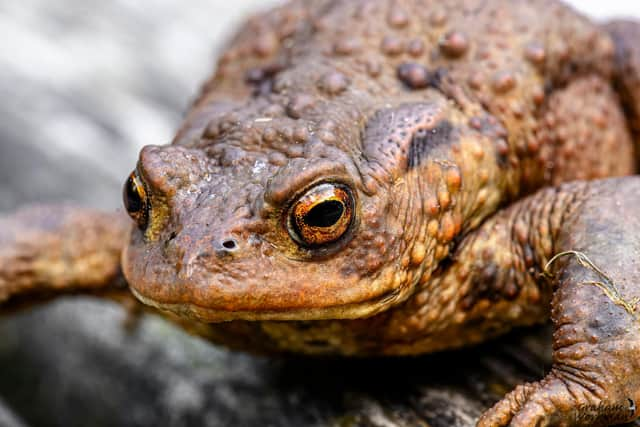

The largest I’ve seen for many a year – he waddled out from behind a couple of buckets, gave me a long disapproving stare and then shuffled back into his hiding place.
Toads are definitely our friends as they manage life in unpleasant places and feast on things we’d prefer not to have as neighbours.
As everyone knows – toads taste lousy (I once licked a toad to see if they tasted as bad as people say – they truly do and I won’t be doing it again in a hurry – uurrrrrgggghh).
Most toads have lumps over their bodies and they have two quite large ones on the back of their heads; these are parotoid glands, which produce a chemical substance.
In some toads, this makes them taste terrible to the animal that is trying to eat them.
A few species on every continent, however, do produce highly toxic substances that can be harmful to humans.
They secrete the substance in self-defence, such as when they feel like they are about to be somebody's dinner.
The poison from the poison dart frogs in South America is obtained only after they hold the frogs over a fire.
In captivity the frogs don't produce the toxins which originate from the insect food the frogs eat.
Toads come into the spotlight at this time of year and if you’re a fan of Shakespeare you’ll recognise this: “Fillet of a fenny snake, In the cauldron boil and bake; Eye of newt and toe of frog, Wool of bat and tongue of dog, Adder’s fork and blind-worm’s sting, Lizard’s leg and owlet’s wing, For a charm of powerful trouble, Like a hell-broth boil and bubble.”
Amphibians and reptiles have long been associated with the occult, having deep rooted ties to our ancient folklore and mythology.
But these days there’s not many who have an un-rational fear of our frogs and toads –unless you have "amphibiphobia" (couldn’t think of the word so I made this one up) and if you come across one you’d be running for cover!
Halloween does give us a good opportunity to look at some of these myths and folklore to see if witches did (or still do) go around carving out newt eyes, leaving hordes of blind newts stumbling around in the countryside (and with great crested newts you could be prosecuted just for touching one, never mind torturing the poor critter just for its eyes).
It has been suggested that during Elizabethan times in England, occupations such as midwives, herbalists and healers were readily and often maliciously deemed as witches or devil worshipers due to the secret ways they mixed herbs and potions to "cure". Or sometimes when coins passed hands ‘"curse" friends or enemies!!
No t’internet or readily available books to check if a plant or concoction was safe to use, they relied on knowledge passed down through generations to create safe herbal remedies.
Then to keep this knowledge to themselves and to protect their livelihoods, the ingredients had to be shrouded in mystery!
Here is where more than likely the ‘orrible’ things like animal eyes, ears, tongues and noses came into being.