
Wildlife expert Graham Workman profiles one of Wigan's most efficient anglers: the heron
An introduction to a bird most commonly seen around Wigan’s open waters, standing stock still, patiently waiting for their next meal to swim by.
“A grey-backed bird, with long legs, a long, white neck, bright yellow bill and a black eye stripe that continues as long, drooping feathers down the neck.”
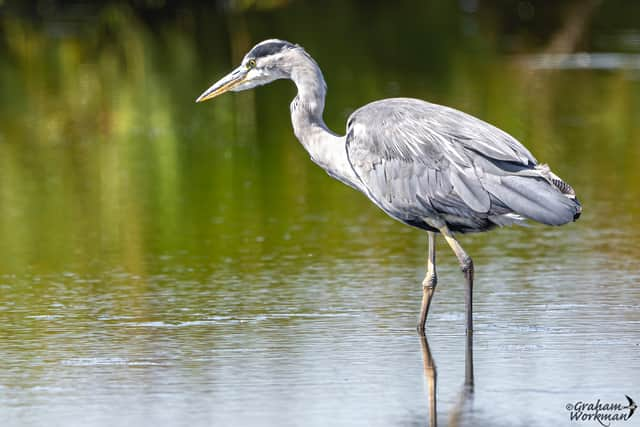

There aren’t many birds with that description so I must be talking Heron – and this one looked very happy up to his knees in the water stalking around the pond edges and then into the deeper parts of the Swan Pond up here in Haigh.
A heron’s diet is a pretty broad and varied affair. Although they primarily like eating fish and amphibians, they are not that fussy and if it’s on offer will happily feed on small rodents, reptiles and even birds.
They are more often than not encountered standing as still as a statue on their long, thin legs in shallow water patiently waiting for their next meal to swim by.
When feeling particularly lazy, the heron will visit gardens with ponds for a quick and easy snack.
Our neighbour lost his pride and joy collection of Koi carp to one individual who sussed how to manoeuvre between the taught lines of string that criss-crossed the surface of his garden pond.
Thankfully he put it down to experience and a better fitting net soon covered the surface which did its job and kept the heron out.
The family that herons belong to are (mostly) tall, long-legged, long-billed wading birds.
They can be found in wetlands throughout the world, searching for fish, crabs and as I mentioned occasionally, frogs, small mammals and even young birds.
They are aided in this by the arrangement of the vertebrae in their neck (they have the same number as other birds), which are constructed to form a hinge with which they can spear a fish with astonishing rapidity.
There are basically three groups of heron-like birds.
The herons, which are usually colonial, nest in the tops of trees; the Heronries Survey run by the British Trust for Ornithology is the longest running single species survey in the world, having started in 1928.
The egrets, are similar tall birds, but with an all-white plumage and long head plumes then finally, the bitterns which are solitary, secretive creatures of reedbeds, where their cryptic brown plumage camouflages them well, making them extremely hard to see.
We are lucky in that bitterns are regulars in some of our larger reedbeds locally.
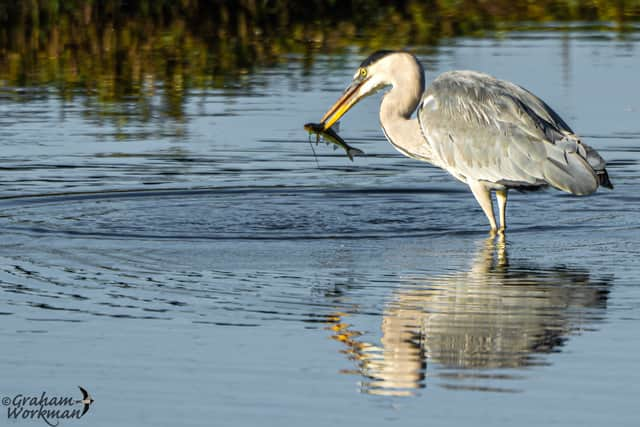
As you can see this one’s stalk was rewarded by a breakfast fish which soon vanished down its gullet.
One special adaptation that results in successful hunting in water is the heron’s eyes.
Herons bypass the optical illusion of water refraction by aiming their strikes lower and closer to their bodies than where the fish visually appears to be.
Because light bends (refracts) when it moves from water into air, submerged prey always looks shallower and farther away than its actual location.
Herons account for this discrepancy through a mix of precise head geometry and learned behaviour.
A heron's brain instinctively balances a mathematical equation known in physics as Snell's Law.
Research on herons reveals a strict correlation between the bird's eye height above the water and the depth of the prey.
By knowing exactly how high its eyes are, the heron automatically knows how much the light is bending and compensates by lunging deeper – how clever is that then?