
Wildlife columnist Graham Workman reports back from Norway where he met an extraordinary bird
In his latest Nature Notes column, wildlife expert Graham Workman reports back from Norway where he encountered an extraordinary bird called the wryneck
Another bird we managed to catch up with in Norway was a wryneck.

It’s not a common bird here in the UK; in fact not a common bird anywhere to be honest.
It was once a breeding bird in the UK, but now it is usually only seen when it is passing through on migration in spring and autumn between Scandinavia and Africa.
The wryneck’s decline started as long ago as the 1850s, but it wasn’t until the early 1970s that breeding finally stopped in England (though there have been a few isolated records since).
Though spring migrants are regular in England, most records are in the autumn.
The best place to find one is on the east coast, but birds occasionally occur in gardens far from the coast, stopping to feed for a couple of days before moving on.
Wrynecks are a member of the woodpecker family and in my humble opinion the most fascinating member of this distinctive group of small Old-World woodpeckers.
The scientific name Jynx torquilla from latin translates to "the twisting bird", describing its remarkable ability to rotate its head nearly 360 degrees and writhe its neck like a snake when agitated or threatened.
Other old names include twister, writhe neck and snake bird, all referring to the bird’s ability to turn its head and neck around and the fact that when startled it can hiss like a snake.
There are several videos on You Tube showing precisely how it got its name, and they are definitely worth a look.
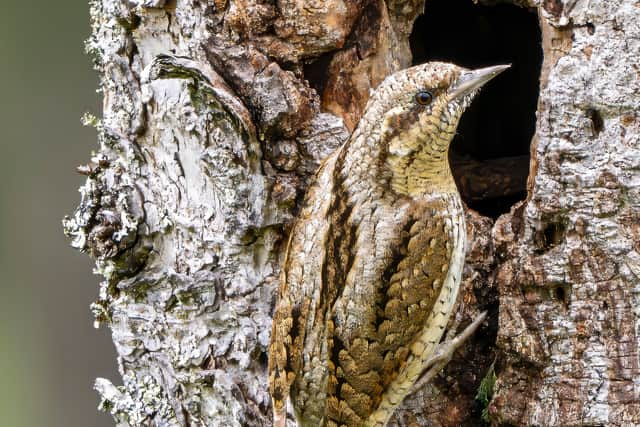
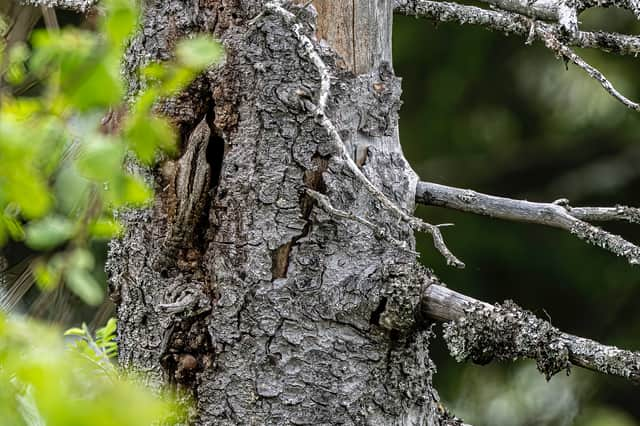
The wryneck’s appearance is very “cryptic,” to say the least and the first shot shows just how well they “merge” into the background and with their small size are really easy to overlook.
The broad black stripe down middle of crown and back is a distinguishing feature and, as you can see from the photos, really stands out.
In spring the male’s constantly repeated plaintive call draws attention to its presence.
This one was very noisy and the call drew our attention to its presence on the old tree.
Being so noisy was a good indication that it must just have arrived back to its the breeding grounds as the calling stops as soon as the first eggs are laid.
Like the woodpeckers, it is a hole-nesting species and will frequently take over nest holes already in use by other birds.
They will, in fact, “evict” other birds they find occupying a nest hole they think will be perfect for them!
One unique feature of the wryneck is that it spends much of its time looking for food on the ground searching of its favourite food: ants, mostly their larvae and pupae, picked up by its extremely long and sticky tongue.
It will also feed on other insects, such as grubs, small beetles, woodlice, aphids, and flies, which are occasionally found on tree trunks and thick branches.
When the wryneck is on tree trunks, the incredible camouflaged plumage patterns enable the bird to practically disappear against the trunk.