
Wigan wildlife columnist Graham Workman introduces us to the great grey owl
Wigan wildlife columnist Graham Workman introduces us to a very elusive owl he found in Scandinavia
Of all the Eurasian owls Strix nebulosa - better known as the great grey owl - has been on our target list for years.
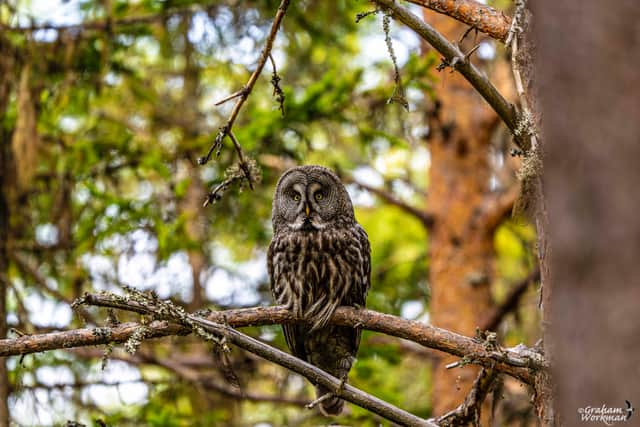

And finally, on a Dad and Lad adventure to Norway earlier this spring actually spend time watching one was fantastic. A dream come true.
Despite its large size the great grey owl is a pretty elusive bird and is never easy to find.
Even in perfect habitat it can be invisible depending on where it has decided to roost.
Luckily an English birder living in Norway knew the exact location of a pair using a nest box, so we were pretty confidant we’d finally see one.
As we approached the female, who was off the nestbox, had obviously seen/heard us and let us know she had by clicking her beak and letting out a couple of loud “whooooos” and a grunt!
We stayed a good way off from where Simon spotted her on a branch as they will actually attack humans if they get too close to their nest. Believe me that would not be a pleasant experience.
More importantly we didn’t want to disturb her in any way. I took laterally hundreds of photos and here’s one I haven’t shared before .
The great grey owl doesn’t have ear tufts, but its first claim to fame is that it has the largest facial disc of any raptor.
A what? I hear you mutter.
A facial disc is a concave, circular arrangement of stiff, densely packed feathers on the faces of certain birds, most notably owls.
The great grey’s is, according to scientists, perfect in its shape and it also has the ability to “move2 these feathers.
It’s a natural satellite dish which they use to track sound while hunting!
One of my favourite things with their plumage is the white gentleman’s moustache.
I had an ex-RAF master at school who had a pilot tash just very similar.
Some say it’s a white collar or "bow-tie" just below the beak but in my humble opinion its def a tash.
You can see from the photos they have quite long tails which taper to a rounded end.
Both its common and scientific names are well suited for this large grey owl.
With regard to its Latin, strix means to utter shrill sounds and nebulosa means misty or cloudy, referring to its grey colour.
In another‘claim to fame, GGOs are the world's largest species of owl by length.
Its massive size is very deceptive, though. Basically it’s a medium sized-owl covered in very, very fluffy feathers, with a large head and, as I mentioned before, a long tail: in fact the longest tail of any owl. Their length ranges from 61 to 84cm.
Their prey include voles, mice, shrews, squirrels, weasels, small birds and, strangely, frogs.
They will hunt during the day and at night. They are real ambush hunters, listening and watching from a perch, then swooping down when they locate prey.
They are silent in flight, allowing them to surprise their target.
Great grey owls live between 10 and 20 years in the wild and have reached over 40 years in captivity.