
Nature Notes: after a misty morning in Wigan, Graham Workman explains the difference between fog and mist
In this week’s Nature Notes, Graham Workman discusses mist and fog.
Sunday morning in Haigh was a good example of how mists can change something usual into something very unusual!
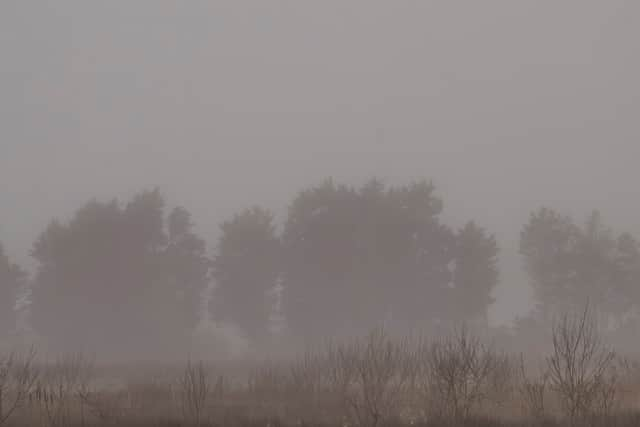

An early morning wander in the woodland was turned into something special by a blanket of dense mist that formed overnight.
Trees take on some pretty sinister shapes and the slightest breeze gives the mist “body” that moves wispy shapes through distant spaces between trees.
It was a very “heavy” mist so within a few hundred metres of leaving for our walk, I could see the moisture left on my coat.
Why was it a mist and not a fog?
If I was driving I think I would have said, “Grief, it’s foggy!”
The only difference between mist and fog is visibility.
This phenomenon is called fog if the visibility is one kilometre or less (in the UK for driving purposes, fog is visibility less than 200m, for pilots it is 1km). Otherwise it is known as mist.
Seen from a distance, mist is bluish, while haze is more brownish. I must admit Sunday morning’s mist was definitely more whitish than blue!
When warm air passes over colder sea or land surface, the air in contact with the colder surface cools.
If the air is cooled below its dew point, it releases moisture and the water droplets settle on the land surface - this is dew.
Some of the water droplets settle on the dust particles, pollutants and salt in the air. They remain suspended in the air, as they are very small and light, and form mist.
For mist, the size of water droplets is less than one micron and the visibility is about 1km.
When the size of water droplets increases to between one to 10 microns, the mist becomes dense and is called fog. Mist is always there before and after fog.
I remember the old “fogs” of my childhood when visibility was down to a couple of metres.
In fact, I remember a journey from London to Cumbria when we gave up driving on the motorway, pulled off at a service station and waited out the night and a much clearer morning.
In the 1950s, London, as well as most cities, was hit by dense, green-yellow fog that choked the streets.
Cars edged forwards with passengers on the bonnets shouting instructions, as drivers could not even see as far as their headlights.
In London’s East End, people could not see their own feet. Yet dock workers reported that, in crane cabins 50ft above the ground, the skies were quite clear.
The scale of the pollution was incredible. Every day, 1,000 tonnes of smoke belched from London’s chimneys, emitting 2,000 tonnes of carbon dioxide, 140 tonnes of hydrochloric acid and 14 tonnes of fluorine compounds.
Even more deadly, 800 tonnes of sulphuric acid was formed as sulphur dioxide coming from chimneys mixed with moisture in the air.
The acid burned the back of the throat, bringing on choking fits, caused inflammation of the lungs and thousands died.
Thank God that the legislation on clean air had a real impact and “pea soupers” are a thing of the past!
I must admit I love a good mist and, as it’s not environmentally harmful, I do enjoy a misty wander in the woodland!