
Nature Notes with Graham Workman: big beasts of the Arctic
Going through some photo files from this summer I thought I’d share some photos and info on one of the species I was desperate to see and photograph.
Walruses are pretty impressive beasts when they are being very 'giddy' battling when you're sitting 15ft away in a rubber Zodiac!
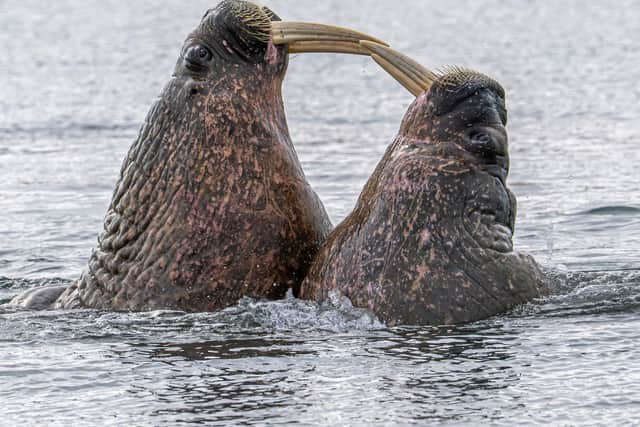

Their tusk clashes are surprisingly noisy and the sound carries a good distance.
Walruses use their tusks for a variety of purposes, including hauling themselves out of the water, breaking breathing holes in ice, fighting with other walruses, like these two and for defence against predators.

Both males and females have tusks, which are actually large canine teeth that grow continuously throughout their lives.
They can reach the good old age (well for a walrus) of 40 years plus.
Sadly, as the Arctic opens up to more shipping, eco-tourism, industry and noise, the Atlantic walruses are at greater threat of disturbance.
Although commercial hunting of walrus populations has not occurred since the mid-20th century, hunting for subsistence purposes is still permitted in Canada, the United States, Greenland and Russia, with a small walrus sport hunt allowed in Canada.
Norway is the only range state that prohibits the hunting of walrus. Well done Norway!
This is a bit "wordy" but indicates in detail what’s happening:
According to the report, Hauling out: International trade and management of walrus (PDF, 3.2 MB), on average up to 5,406 walruses (555 Atlantic Walruses Odobenus rosmarus rosmarus and 4,851 Pacific walruses O. r. divergens) were hunted per year from 2006/2007 to 2010/2011. This equates to less than three per cent and four per cent respectively of the estimated global populations for each subspecies.
International trade in walrus parts and derivatives is regulated by the Convention on International Trade in Endangered Species of Wild Fauna and Flora (CITES). Based on CITES trade data on walrus skulls and tusks, between 461 and 772 walruses were represented in international trade during 2005 to 2009, an average of 92 to 154 per year. The majority of the skulls and tusks were from Atlantic walrus.
Overall, the report finds a lack of long-term data and poor quality of information on population estimates for walruses making it difficult to determine the true impact of international trade or what the current or future impact on walrus populations will be from climate change.
Currently neither illegal hunting nor illegal trade appear to be at levels that would cause conservation concern.
The report therefore recommends a number of steps to improve monitoring of international trade in walrus parts and steps to obtain better data on the population size, trend and demographics of both Atlantic and Pacific Walrus populations to ensure harvest levels are sustainable.
The last photo gives you some idea of their actual size - they are massive.
The Arctic is definitely somewhere I'd like to visit again - especially in summer when there's 24-hour sunlight for weeks and weeks - allowing for very long days out with the camera.