
In his latest Nature Notes column, wildlife expert Graham Workman introduces us to painted lady butterflies
The painted lady butterfly is the subject of wildlife expert Graham Workman’s latest Nature Notes column
So far it’s been a good year for butterflies locally and hopefully we’ll turn up even more later in the summer.
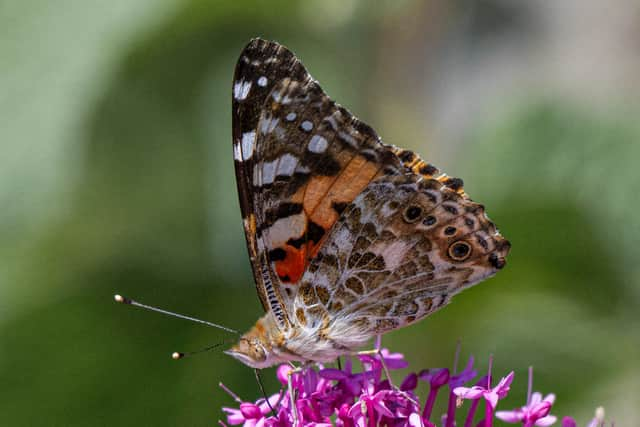

If you remember a few years or so ago there was quite a bit of excitement nationally as well as locally with the mass migration of painted lady butterflies that had left their sunny homes in the mountains of Morocco to holiday in warm and sunny UK.
Not long ago in one of our wetland reserves I came across a caterpillar that I didn’t recognize.
It was obviously a butterfly caterpillar – a mixture of black, reds, yellows with lots of evil looking hairs and small spines – to be honest it was quite easy to guess it was a painted lady caterpillar as the colour is very similar to those on the butterfly.
The caterpillar makes a sort of tent from thistle leaves on which it then feeds, and once it has chomped its way through the leaves inside of its little tent home it moves on to start again.
I must admit the shiny pink and dusky grey chrysalis is particularly attractive.
The painted lady butterfly has a peach-to-pale-orange background colour, with brown and white patches more noticeably on it upper forewings.
Spots below the margins may have blue centres.
The under wings are a paler version of the upper wings, with more variation of colour, mottling and pattern on the hind wing.
The female is very similar looking to the male. It has a couple of delightful scientific names - Cynthia cardui or Vanessa cardui (obviously sisters)– both sounding more like a French film star than a butterfly.
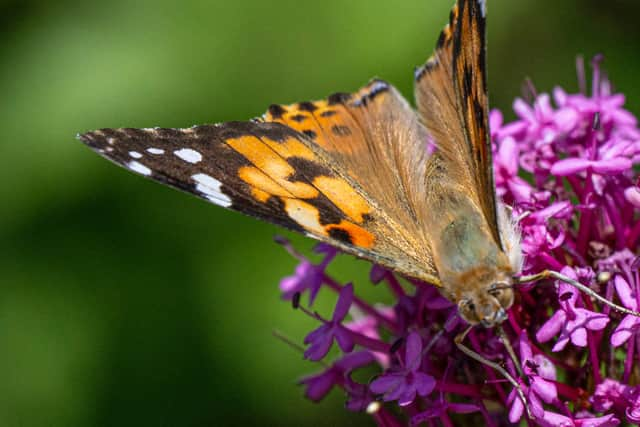
The painted lady is somewhat of a long-distance traveller at times, which when the conditions are right produces probably the most spectacular butterfly migrations in Britain.
Every year the painted lady spreads northwards from its usual home on the desert fringes of North Africa, the Middle East, and central Asia, re-colonizing parts of mainland Europe and reaching Britain and Ireland.
In some years, like I mentioned, when everything is right it is an abundant butterfly, seen in gardens and other flowery places in late summer.
The last massive influx I remember was in May 1997 and at the time could have been the biggest influx of butterflies into this country in decades.
It began with literally millions arriving into Britain from the deserts of north Africa.
Up to 18,000 were spotted sailing on the breeze across Scolt Head Island on the north Norfolk coast: 50 arriving every minute according to Natural England nature reserve staff.
It hasn’t been anywhere like that this year but enough has arrived to make looking for butterflies interesting.
Marcus and I had a Dad and Lad Trip to the RSPB Nature Reserve in Conwy at the weekend hoping to see the Western Reef heron (a first for the UK).
It had been there for around two weeks – but of course we arrive and the heron departs. Another failure – but I’m sure a return trip is on the cards for next week.
In compensation we did manage to see and get these shots of a very obliging painted lady. Steady!