
A Wigan food firm and its packaging supplier are cutting waste with reusable containers that last six years
Long-running Wigan food ingredient firm Ellsey’s, famous for its vinegar, is part of a pioneering partnership when it comes to sustainability and reducing waste.
A long-standing partnership between Wigan food ingredient supplier Ellsey’s Vinegar and industrial packaging manufacturer WERIT UK is helping reduce packaging waste, lower operational costs and support sustainability goals across the food manufacturing sector.


Today, more than 2,000 WERIT Intermediate Bulk Containers (IBCs) — large, reusable industrial containers used for storing and transporting liquids or bulk materials — are in circulation across Ellsey’s operations and customer network, transporting several million litres of vinegar annually to food manufacturers throughout the UK and Ireland.
When properly maintained and inspected, each IBC can remain in service for up to six years, significantly reducing the need for single-use packaging and lowering overall material consumption.
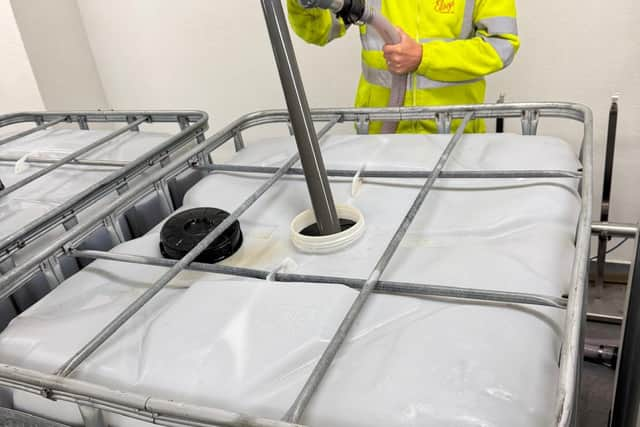
Rather than disposing of containers after use, Ellsey’s collects, inspects, cleans and refurbishes its WERIT UK IBCs before returning them to service.
Components can be repaired or replaced when required, extending container life and significantly reducing the need for new packaging.
The system's longevity is underpinned by WERIT's IBC design. Unlike earlier container systems that Ellsey’s used, which relied on wooden pallets and steel components prone to corrosion.
WERITs are fully plastic pallets, galvanised vertical steel bars, and replaceable parts, which reduce maintenance, improve hygiene and durability.
The approach delivers environmental benefits by reducing waste and lowering demand for raw materials, while also helping customers avoid the costs of continually purchasing new containers.
Tim Williams, managing director at Ellsey’s, said: "Food safety is non-negotiable for us.
“The BRC framework has transformed how businesses across the food supply chain work together by providing a recognised benchmark that customers trust.
“Having suppliers who understand those requirements and can consistently support them is extremely important.
“WERIT's modern IBC design, with its fully plastic pallet, galvanised vertical steel bars, and replaceable components, has helped us improve durability while reducing maintenance requirements.
“By preventing corrosion and making refurbishment easier, the containers remain fit for food manufacturing for up to six years, supporting both our sustainability objectives and operational efficiency."
Food safety is fundamental to the partnership, with both Ellsey's and WERIT operating to the same BRCGS AA Grade standard, demonstrating a shared commitment to the highest levels of quality, compliance and supply chain assurance.
Jason Waywell, national sales manager at WERIT UK, said: “Manufacturers are increasingly looking for practical ways to reduce waste without compromising quality, compliance or performance.
“Our partnership with Ellsey’s demonstrates how reusable, food-grade IBCs can support circular economy principles while delivering real-time operational and environmental benefits.”
Ellsey’s has used WERIT IBCs, manufactured from FDA-approved materials, for several years, developing a collaborative relationship that has helped optimise container performance and support continuous improvement.
As food manufacturers face growing pressure to improve sustainability throughout their supply chains, both companies believe reusable packaging systems play an increasingly important role.
By extending the lifespan of food-grade containers and reducing reliance on single-use alternatives, the partnership demonstrates how businesses can achieve environmental gains while maintaining the highest standards of product safety, traceability, and quality.