
Wildlife columnist Graham Workman introduces us to a colourful bird that eats its own feathers
Wildlife expert Graham Workman explains why his favourite species of grebe likes to swallow its own feathers
The Slavonian grebe. (Podiceps auritus) is, in my humble opinion definitely the most attractive of our breeding grebes here in the UK.
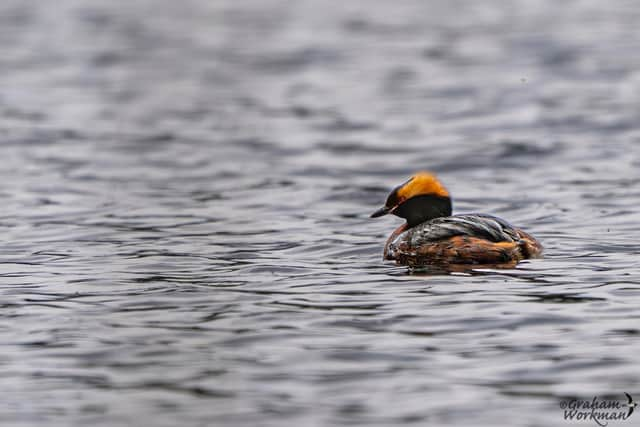

Those golden ear tufts, caught in sunlight, seem actually to glow.
Then their blood-red eye surrounded by the golden feathers is another stunning feature of this small waterbird.
Those tufts give the grebe its American name: the horned grebe.
Size-wise Slavonian grebes are larger than our smallest species of grebe: the little grebe or dabchick.
Slavonian grebes measure around 31 to 38cm in length and have a longer body, a flatter crown, and a more slender, elongated shape compared to the diminutive little grebes which are about 23 to 29cm in length.
Sadly, the small and fragile breeding population is declining and is concentrated on a small number of lochs and lochans in the north east of the Scottish Highlands.
To put into perspective just how rare they are, there are fewer than 40 pairs breeding!
We had a trip up to one of these lochans to see them in their breeding finery and was well worth the 700+mile return trip.
There were two breeding pairs on this loch and, being such a colourful bird, you’d think they would stand out on a bleak lochan.
They didn’t and it took us a while to actually find any of them occasionally popping out of the sedge beds in a couple of areas of the water
In winter the bird is completely unrecognisable from the spring and summer breeding plumage bird.
They are like most of the grebes in winter plumage: basically dark above and white below.
The winter population increases to over a thousand birds.
These occur close inshore around our coasts of Britain and Ireland, with the main concentrations usually focused around sheltered Scottish waters.
They are also present around the North Sea coast of eastern England.
Research has shown a significant expansion in their wintering range over the last 20years or so.
Slavonian grebes are classified in the UK as Red under the Birds of Conservation Concern 5: the Red List for Birds (2021).
They are protected in the UK under the Wildlife and Countryside Act, 1981, and listed as Vulnerable on the global IUCN Red List of Threatened Species.
So what other grebes are in the UK? Quite a few to be honest, but these other species are not common and some are very difficult to find.
Here’s the list of all the grebes that breed in the UK:
- Little grebe
- Great-crested grebe
- Red-necked grebe
- Slavonian grebe and
- Black-necked grebe
Factoid: Slavonian grebes regularly eat their own feathers!
These feathers form a sort of natural filter in the birds’ stomachs.
As they feed on many small fish it’s believed that this filter stops the small fish bones and keeps them in the birds’ stomachs long enough for the bones to dissolve and be digested.
How clever is that then?
The parent birds have been seen feeding feathers to their chicks.