
Nature Notes: Graham Workman looks at the return of avocets and the difference made by the RSPB
In this week’s Nature Notes, Graham Workman looks at the avocet.
A real celebrity bird!!
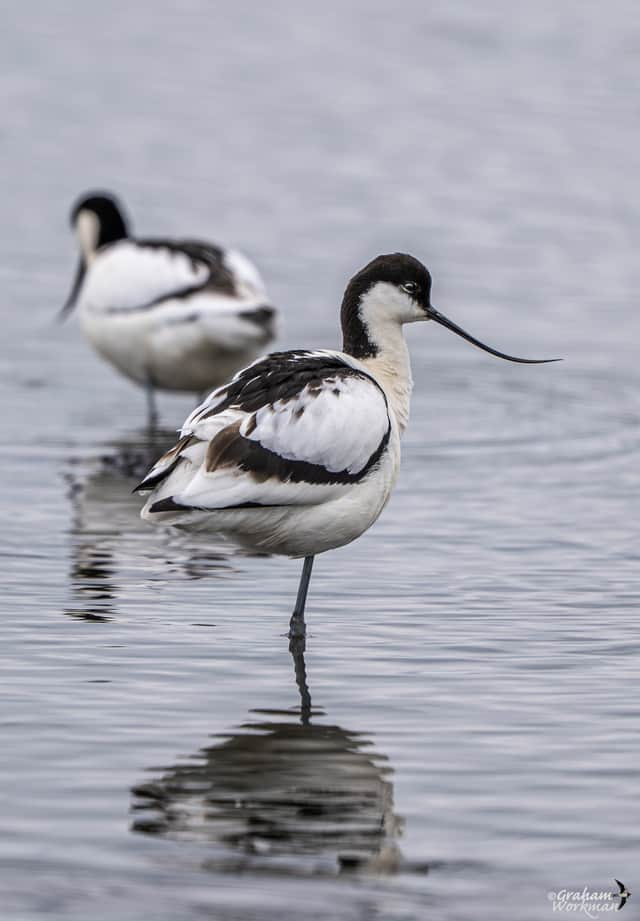

Back in 1840 due to habitat loss, particularly through drainage of wetlands, avocets were lost as a breeding bird in the UK.
Then around 100 years later, in the1940s, a few pairs returned and attempted to breed.
This was so “special” that the nests were actually guarded 24 hours a day to make sure no egg collectors raided the nests to steal the incredibly rare eggs!
Being a very easy bird to identify, with its long blue legs, stunning black and white plumage and its thin upturned black bill, in 1970 the RSPB selected it as their logo.
Praise where praise is due, it was down to the RSPB conservation land management and wetland creation that brought avocets back into the UK as a breeding species.
They feed on insects, shellfish and worms, which they find by touch in mainly muddy water by sweeping their open bills sideways through the water.
Their bills are so sensitive they can find the smallest water snails and other small molluscs and crustaceans.
The avocets’ nest is pretty much just a scape lined with a few pieces of reed, always on bare ground and close to water.
What they eat and where they nest pretty much determines the habitat where they’ll nest.
Their preference is usually shallow lagoons with brackish water (all on offer at Martin Mere WWT where these photos were taken). Then in winter they head for the estuaries and mudflats.
Mentioning Martin Mere, in May 2005 it was our middle daughter Tara’s eighth birthday and instead of a big “girlie party”, she wanted to go to Martin Mere wetland reserve and see the ducklings!!
So, we had a deal – we would look at the birds in the collection and then off to the hides to see what “wild” birds where about.
When we got to the hides I must admit I didn’t believe my eyes at first – tucked in with the mixture of ducks and godwits were a pair of avocets mating!!!
This wasn’t right, or was it – avocets shouldn’t be here?
It turned out, when we got chatting with one of the staff, that this pair had just flown in – but another pair had nested and raised a chick over on the other side of the reserve, and to make the point that we do have suitable habitats in the North West, they had successfully bred last year in 2004 as well!!!
Since then, avocets have gone from strength to strength and are now a pretty common sight in our wetlands and estuaries in winter.
Now, as they spread along the east coast, breeding avocets can be found in Wales and in the north of England.
In 2018, a pair even bred in Scotland for the first time at RSPB Skinflats.
Today, there are an estimated 1,950 breeding pairs, and 8,700 wintering birds in the UK.
It’s so rewarding to think that all RSPB members had an input into this conservation success.