
In his latest Nature Notes column, Graham Workman delights in a rare chance to see and hear a treecreeper
The “frantics” of the bird world are put in the spotlight by Graham Workman in his latest Nature Notes column after a delightful and rare encounter with one in Haigh Plantations.
Since the colonisation of our woods by the real noisy woodland bird, the nuthatch, it’s only the rare occasions that I actually hear a treecreeper’s high-pitched call – on account of my hearing being nothing like it used to be.
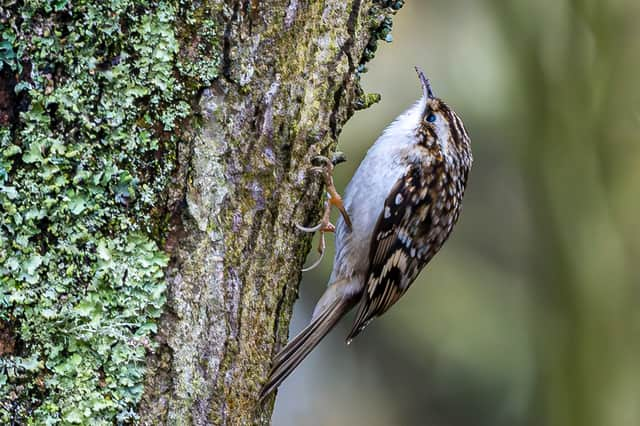

So it was a nice treat the other day in the summer sunshine not only to hear one - as I was that close - but also to watch one too just a few feet away climbing up the trunk of a massive oak trees not far from the cottage.
Treecreepers are generally unobtrusive and are often indifferent to us humans.
They are usually seen as a single bird or in pairs, sometimes in small family groups at this time of year after the young have fledged but still being looked after by mum and dad.
They are small, very active bird that lives almost entirely in and on trees.
The treecreeper has a long, slender, down-curved bill that’s just the job for searching out insects in cracks and crannies.
It is speckled brown above and mainly white below, making it look very much like a mouse as it zooms up the trunk of a tree.
Treecreepers forage on the trunks of large trees.
They move up the trunk in a progression of small hops, then fly to the bottom of the next tree before climbing up in a spiral fashion searching for prey.
Most of their diet is composed of small invertebrates, including insects and their larvae and spiders. It will work its way up trunks in a spiral fashion before dropping down to the base of another tree.
The big problem with trying to watch treecreepers is that they never just sit there and chill.
They are the “frantics” of the bird world always in a hurry to get somewhere or accomplish something.
The winter roosting habits of treecreepers have been studied by ornithologists who have found that the most favoured sites are contained in the soft fibrous bark of redwoods and wellingtonias.
These trees are doubtless chosen due to the ease of excavation and the insulating quality of the bark.
Luckily here in the Plantations at Haigh we have a number of both redwoods and wellingtonias so there will be somewhere for them to nest and roost in for the next several hundred years at least.
The treecreeper handles any enlargement in the morning and evening, pecking away chips and scraping with feet.
Most roost hollows are found about 8ft from the ground and below the lowest branches.
They may be on all sides of the trunk or mainly on the sheltered side to which the bird would anyway tend to move in wind or rain (who said birds don’t think and only act by instinct).
Changes of tree are probably also due to weather conditions.
All trees may be abandoned on very stormy nights.
A given creeper does not always roost in the same hole and will, according to the literature, occupy a roosting chamber used previously by another bird.
Some trees may contain 10 or 11 holes; others, apparently just as suitable, none.