
In this week's Nature Notes, wildlife expert Graham Workman discusses the pros and cons of bluebottles
Wildlife expert Graham Workman introduces us to the humble bluebottle and while it won’t be high on many people’s list of favourite creatures, he is keen to explain its benefits to our ecosystem as well as its drawbacks to our health
There's an alien world surrounding us which I find absolutely fascinating although I do understand these critters are not to everyone's liking.
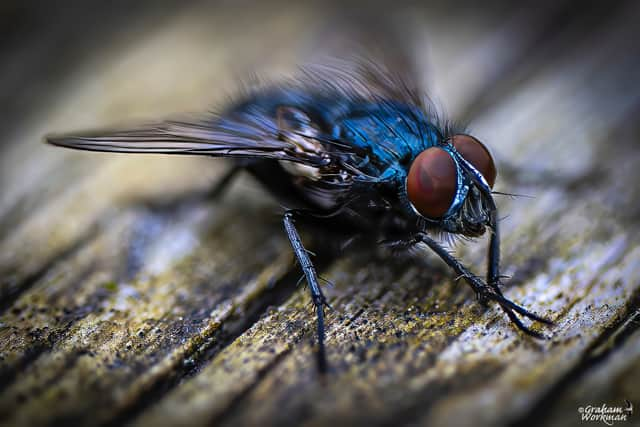

Thankfully the inhabitants of this world are small enough not to be too scary.
But dog-size and larger they would become things best left to our nightmares.
There are food chains and skilled predators just as complex and raw as any Serengeti or Amazonian Adventure.
This bluebottle, for example, plays an essential role in being on of nature’s recyclers and has a vital role in the ecosystem, breaking down decaying organic matter and pollinating specific plants.
Their larvae (maggots) appear by magic and feed on dead animal carcasses, dung, and rotting waste, accelerating the breakdown of organic material.
By consuming and processing this dead matter, they return vital nutrients like nitrogen and carbon back into the soil.
Then, being a bluebottle, you are wanted by so many other creatures - and wanted not in a good way.
Both the adult flies and their larvae provide a high-protein food source for a host of predators, including other invertebrates like spiders, wasps, dragonflies, birds, reptiles, amphibians, and fish.
Adult flies feed on nectar and any other sugary or sweet substance for energy and are attracted to strong-smelling flowers (such as those in the carrot family) that mimic the scent of decaying meat, assisting in the pollination of these plants.
So yes, they can be a real pest but they do such good work that sometimes we should cut them some slack and a slight nod and silent “thank you” wouldn't go amiss.
So to be fair we really need to look at the negative side to bluebottles.
As well as being really noisy and annoying when you can hear them somewhere in the room, it will take hunt to find it.
Plus when you do find it, actually swatting it is another storey altogether.
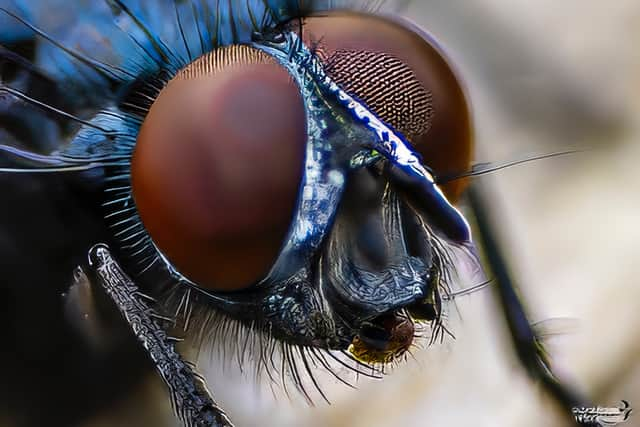
Look at the photo, especially its eyes, and you can soon see why they seem to have a sixth sense when it comes to being “swattable.”
As I said, bluebottles feed on decaying matter, rotting meat, garbage, and animal faeces.
So as you would expect pathogens stick to their bodies, legs, and footpads as they explore these unclean environments.
Probably the worst of all the negatives is to enable them to eat solid food.
Bluebottles actually vomit digestive juices onto it to liquefy it before slurping it back up, transferring millions of bacteria directly onto human food sources and surfaces.
Thankfully they don’t bite or sting, but landing on kitchen counters, utensils, or uncovered food transfers germs and what a mix of nasties they can leave for us.
They can carry food-poisoning bacteria like salmonella, e. coli, listeria, and campylobacter.
Historically and environmentally, they have been linked to vectors carrying some real nasties such as dysentery, cholera, typhoid fever, and tuberculosis.
In rare instances, blowfly larvae can infest open wounds or neglected tissue, causing a parasitic condition known as myiasis.
So like most things in life there are two completely opposing sides to the bluebottle.