
In his latest Nature Notes column, Graham Workman explains how pheasants arrived on these shores
Graham Workman's latest Nature Notes column delves into the fascinating history of pheasants in Britain, tracing their origins back to the Roman Empire.
In 55 BCE the Romans arrived on our shores in their galleys and gave the island the name Brittannia and with them came a very common bird.

This first “invasion” was led by Julius Caesar and was a brief military expedition to the coast of Kent in 55 BCE.
He did not conquer the island, returning instead to Gaul after securing temporary tributes and hostages.
He returned with a larger force in 54 BC, but permanent rule was not established until a few years later.
The true conquest and occupation of Britain began in AD 43 under Emperor Claudius.
General Aulus Plautius led the invasion force, successfully establishing Britannia as a lasting Roman province.
It is thought that the name comes from a Celtic name Pretani – meaning “the painted or the tattooed ones.”
It's also probably worth mentioning that the island of Britain being a single state didn't happen until 1703.
So, before that, it would have been used much more as a geographical term.
In the 6th century, Britain would have comprised of many smaller kingdoms that would eventually coalesce into one kingdom.
Getting back to the wildlife theme a very familiar gamebird has an interesting history with Brittannia.
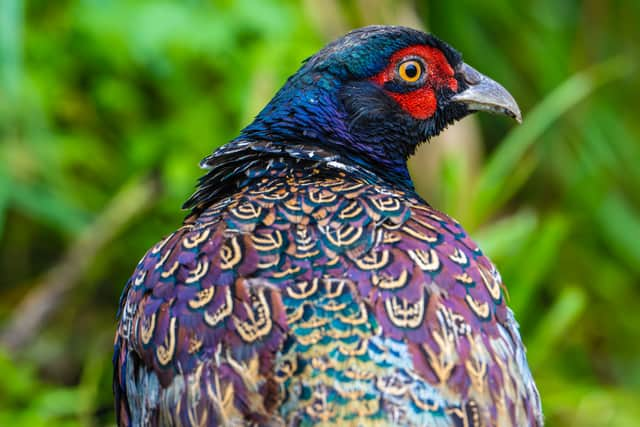
A very familiar and common gamebird, our pheasant is large and colourful and has a long tail.
Common in farmland and woodland throughout the UK, the males' loud, sharp, croaking call can be heard resonating through the countryside before the bird is actually seen.
Pheasants eat seeds, berries, leaves and insects; they roost in trees and can form flocks in winter.
During the breeding season, one male may mate with many females, who then raise the chicks alone.
So when and where do they actually originate from? That’s an easy answer. They are native to Asia and it’s from here the Romans brought them to Brittannia.
The Roman (Latin) name for the pheasant was phasianus.
According to classical myth and writers like Pliny the Elder, the Greeks and Romans believed the bird came from the Phasis Valley after being discovered during the legendary voyage of Jason and the Argonauts.
Historians believe Roman officers and wealthy citizens brought the birds to Europe and Britain for their tables specifically as a show of wealth and good taste (no pun intended).
There was a long gap when no mention of pheasants can be found in the history books and it’s believed that after the Roman Empire fell, these early introduced pheasant populations in Britain likely died out.
Then in 1066 another invasion by the Normans brought pheasants back to Britain and slowly they became established in the wild.
The first clear written records appear in the 11th century, such as King Harold gifting a pheasant to Waltham Abbey in 1059.
By the 15th century, the birds had become relatively common across the countryside until in the 17th century when, due to woodland clearing and marsh drainage, pheasants were brought close to extinction again in Britain.
But during the 18th and 19th centuries, new subspecies—including the Chinese ring-necked pheasant—were introduced and very showy pheasants, such as the Golden pheasant and Lady Amherst's pheasant, strutted around the landed gentry in their vast esatates.
Now there are over 30 subspecies of Phasianus colchicus which vary in colour from nearly white to almost black due to captive breeding and hybridisation.