
In his latest Nature Notes, wildlife expert Graham Workman focuses on the "Druids' tree" - the yew
Wildlife expert Graham Workman talks about one of his favourite trees which is steeped in history and one of the oldes living organisms in Europe
Well, I finally managed a couple of hours away from my office and reports to get into the wood with my camera.
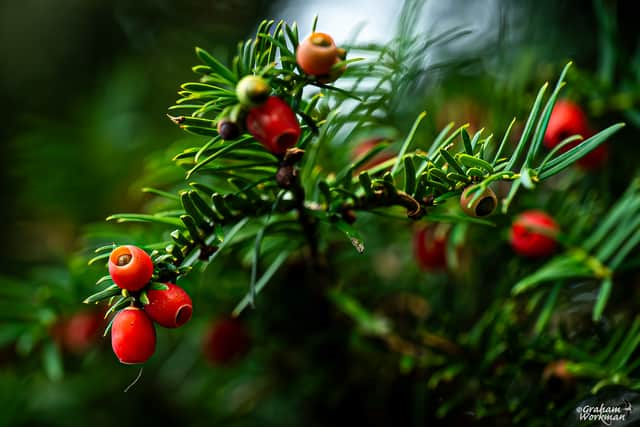

The autumn change over really is beginning to start now with many trees colouring up and coming into fruit.
Anyway, enough waffle: fleshy, flashy berries are developing. The trees had real good crop of berries and a blackbird and mistle thrush were fully tucking in.
Yew trees are definitely up there when it comes to my favourite trees. They have so much rich history, legend, mystery and tree lore associated with them going back to the mists of time and the first people of our island – whoever they were.
It has seeds encased in a soft, sweet, bright red fleshy jacket which, if eaten, are deadly poisonous. Even the needles are poisonous.
But with it being an evergreen tree that lives for thousands of years, it also represents both mortality and eternity.
They have a unique ability to regenerate. As the central trunk dies or hollows out, new branches can drop to the ground and root, or new trunks can sprout from the old root system, symbolizing natural resurrection.
This was probably one of the traits that attracted the Celts, Druids, and Norse and developed traditions that the tree yew served as a bridge between the living world and the spirit realm.
Ancient burial sites and old churchyards usually have a couple of yew trees at least.
There are two trains of thought regarding yew trees in church grounds.
One is that every village with a church had to plant yew trees for eventually being used for the famous and mighty English longbow.
The other is that the churches when Christianly was in its infancy were often put on previously sacred spots (as a safe bet – and not to forget the old gods!)
The yews planted in churchyards were quickly adopted as emblems of everlasting life and the resurrection, with their red heartwood and white sap sometimes likened to the blood and body of Christ.
Yew trees are among the oldest living organisms in Europe, with some specimens estimated to be thousands of years old. It’s easy to see why the Druids held them in such awe.
Here’s a few uses the Druids had for yew –
• They used yew wood and kindling to build Beltane fires to mark the arrival of summer.
• Druids and bards used yew staves or wands for protection, support, prophecy aids, and memorizing long poems or incantations.
• Lengths of yew wood were carved with ancient Ogam alphabets for ritual and magical purposes
If you’re interested in the oldest yew tree in Britain it’s in Fortingall Parish Churchyard, Perthshire, Scotland and is Between 2,000 and 5,000 years old (dating back to the Bronze Age)
One amazing fact which combats their reputation as deadly poisonous trees is that yews are used to make the cancer chemotherapy drug paclitaxel.